
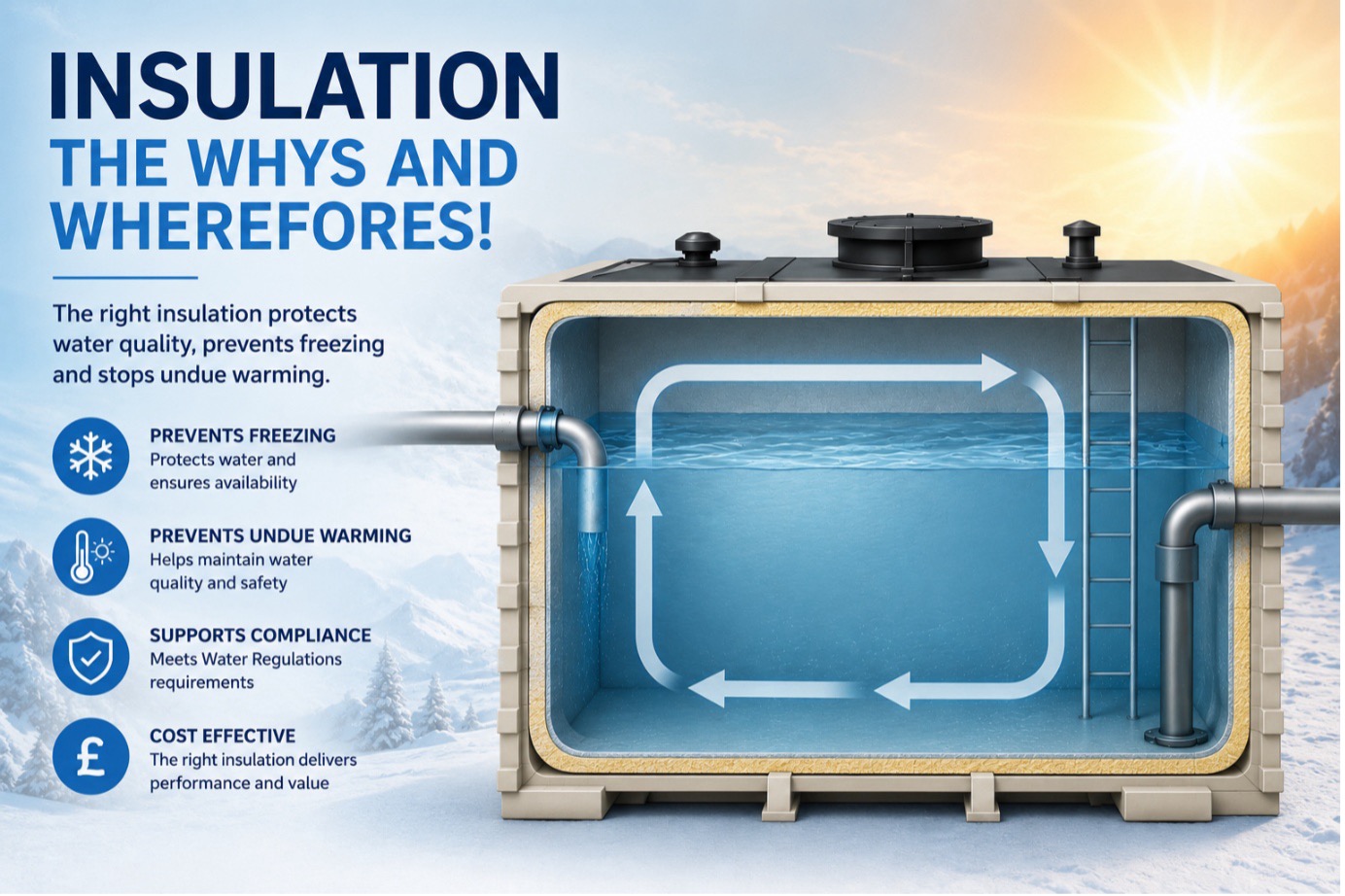
Tank and cistern insulation is a subject, which is prescribed as a requirement in every specification for water storage products but is a very little understood topic. The following may explain why.
Who or what advises that insulating water tanks is beneficial? Arguably, common sense has a voice. In winter, if sufficient heat is lost, the contents will freeze. In summer, heat will be gained and the contents possibly become unpalatable and unsafe.
The Water Regulations state in Schedule 2 -16 (4c) “every storage cistern shall be fitted with thermal insulation to minimize freezing and undue warming.
THERMAL INSULATION IS REQUIRED TO MINIMIZE FREEZING & UNDUE WARMING
The Consideration of WRAS Guidance
BSEN806 and the WRAS Water Regulations Guide also advise on the requirement for cistern insulation. However, little or no guidance is advised as to the degree of protection required, if, dare it be said, if protection is required at all.
Standard practice for GRP tanks is for the specification to advise25mm, sometimes50mm, thick pre-insulation but does not define the type of insulating material. Whereas Cladding Jackets are the norm for thermoplastic cisterns.
Almost assuredly, no indications of the thermal properties of the insulation material are advised. So, who decides?
Trade and practice over the last 15 years or so has seen the use of PU Foam, either in slab or injected form, being sandwiched into GRP laminates. For Thermoplastic tanks, Rockwool or loose fill expanded Polystyrene being a Cladding Jackets’ principle insulating material.
Low density PU Foam provides a high-performance insulating quality with a Thermal Conductivity ‘u’ = 0.02 W/m.k and at lowest cost. Rockwool and Expanded Polystyrene on the other hand offers a ‘u’ value ranging from 0.35 to 0.04 W/m.k again at low cost.
The important factor when designing in or selecting any insulation material is to determine it performance in terms of the rate of heat transfer. That is, the total amount of heat transferred in a given time frame is a function of its thickness, thermal conductivity and total surface area. i.e. Its Thermal Conductance, measured in W/m2. k.
It would be rare indeed to have a consultant’s specification for cold water tanks to advise the thermal performance required of the insulation.
With ever increasing environmental pressures, more and more specifications are requiring the PU Foam to be not only CFC free but additionally, HCFC free of these ozone depleting gases.
What is missed in this rush to keep the planet green is that HCFC free material is approximately 50% less efficient as an insulator than the CFC free standard PU Foam but still the 25mm thickness specification is trotted out as the norm. To provide the same performance of insulation the HCFC free material would require to be half as thick again and, as it happens, at 4 times the cost.
This shows the general lack of understanding of the subject matter. If 25mm thickness was required before why is38mm not specified now?
It is fair to say monitoring the temperature of stored water in certain establishments, (hospitals prisons, etc.) has dramatically increased. However, one wonders how often a tank is drained down because the temperature of the contents is approaching 20 deg. k.
Having set out the parameters related to current tank and cistern insulation practice and the apparent general lack of understanding as to how this is determined, will discuss whether it really is necessary to insulate on all occasions.
Is It really necessary?
The Water Regulations leave us in no doubt. The answer is yes. In essence the Regulations are a catch for all cistern and tank installations and as with the previous Water Byelaws, are written in the main for domestic applications.
However, there are many tanks in service which are not insulated and operating without risk to everyone’s satisfaction. So why is this? The answer is a function of Tank capacity.
Today the main purpose of insulation is health related. i.e. minimising possible heat gain of the water contents such that its temperature at point of delivery is not greater than the recommended UK maximum of 20 deg. C. (by law across Europe wholesome water must not be supplied at a greater temperature of 25 deg. C.)
Insulation fitted for this purpose is also beneficial in frost conditions, restricting the onset of ice formation. Interestingly and worthy of note, BS EN 1057 advises that PU foam only 3mm thick is sufficient to meet this requirement.
Weather Conditions
Two basic scenarios must be considered with variations there on.
1. Summer Conditions: Tank subject to elevated ambient temperature conditions with the increased risk of harbouring legionella bacteria. 2. Winter Conditions: Lower ambient conditions with the potential of contents freezing.
Factors which require to be established at the onset of the assessment are environmental conditions. Parameters common to both Summer and Winter Conditions;
a) Assume no external losses of total energy during heat transfer to and from tank contents.
b) Assume no tank draw off or mains make-up for a 24-hour period.
c) Plastic or GRP tank.
Summer considerations;
1) Tank in unventilated attic. Ambient air temp. 45 deg. C for 10hours in 24 hours.
2) Tank in Basement or Plantroom. Ambient air temperature. 25deg. C for 24 hours.
3) Tank external, subject to direct sunlight. Ambient temp. 25 deg. for 24 hours and roof and 2 sides subject to direct sunlight for 10hours.
4) Initial water temperature taken as 15 deg. C.
Winter considerations;
1) Tank in external environment subject to ambient of -6 deg. C for24 hours.
2) Initial water temperature taken as 7 deg. C.
Taking various sizes of tanks in the range 250 l to 25000 l and subjecting them to the various summer and winter conditions previously outlined and without boring you with the details the following is determined:
For the conditions outlined its not possible for tanks of capacity greater than 4000 l to absorb or release sufficient energy to have their contents reach the respective maxima or minima temperatures of 20 or 0 deg. C.
Summary
For both Summer and Winter conditions a tank with a holding capacity of 4000 l or greater does not require to be insulated. Or put another way, all tanks with a capacity to surface area ratio greater than 240 l/sq. m need not be insulated. Hence all Thermoplastic tanks should be insulated but only GRP Tanks of a capacity less than 4000 l need be.
It is appreciated it would be difficult to explain all this to the Consultant fraternity or Water Inspector however the facts of the matter are that a standard Cladding Jacket or 25mm thick PU Foam provide insulation properties approximately 6 times greater than is necessary.
To further increase insulation thickness either by design or at the requirement of a specification is a complete waste of money.
Useful Downloads:


