As greater monitoring and sophistication becomes a normal requirement of ‘building management systems’ so also does this lead to tanks and cisterns being fitted out with a wide variety equipment items.
The problem generally is not only how to install them, but where. As more and more tanks are required to be positioned in tight or restricted spaces, practical difficulties arise in finding suitable locations for all the ancillary items whilst providing reasonable access for inspection and maintenance.
What type of items are we talking about apart from making provision for the usual Float Valve, Overflow, Warning Pipe and Cold Feed connections?
High and Low Level Switches, Contents Gauges and Temperature Sensors and if the tank has a Division all the above items x 2.
Though not necessarily all items will be required to be fitted every time it is clear the tank so lovingly designed and manufactured with great care to provide the maximum aesthetic appeal is soon to take up the general appearance of a Christmas tree. Such is life.
So what are these items and why are they necessary?
Level Switches provide level detection within a tank and signal generation to remote plant items, which provide indication, alarm or stop / start equipment such as a pump.

High-level detection warns of imminent tank overflow, where as low level, protects a pump from ‘burn out’.
There are many varieties of switch available, from the simple to the sophisticated, i.e.
- Magnetic toggle
- Sealed float
- Pressure activated diaphragm
- Electronic
- Ultrasonic
Each has their particular benefits but generally for water service duty with an accurate detection level at affordable prices it is hard to beat the simple Magnetic toggle switch though the Diaphragm and Electronic types, in their simpler forms, run a close second.
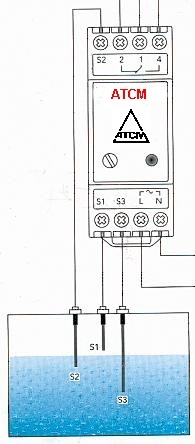
In this regard, the Electronic type (as depicted right) with its roof top fitted probes makes for easier adjustment of the sensing level should that be a requirement following initial commissioning.
Fixed side entry Float Switches don’t have any, or at best, only comparatively little adjustment, with the further costly drawback of the need to re-enter a commissioned wholesome water tank to conduct the readjustment work.
Ultrasonic types, being considerably more expensive, are almost exclusively used with corrosive liquids. No physical contact is made with the liquid as transmitted signals detect the surface level.
Contents Gauges, externally fitted to a tanks external, also come in a number of types. i.e.
- Sight glass
- Cat and mouse
- Dial Type (float / lever operated)
- Dial Type (Pressure transducer)
- Ultrasonic
For wholesome water service the first two named, though having been used since time began in providing accurate level measurement, are not the most health and safety conscious units in these more enlightened times, in terms of maintaining water purity.
Sight Glass type in its simplest form, an external, vertical, translucent tube connected to the tank showing internal liquid level. Regrettably it has the inherent risk of retaining stagnant water with the potential of nurturing bacteria growth and hence contaminating tank contents.
Cat and Mouse type is particularly suited to indicating contained liquid levels when viewed from long distances, e.g. provides indication at 1:1 ratio on a large vertical scale board fixed to a tank side, activated by means an internal float via a wire and pulley system. A tank on a tower installation regularly employs this method. However it requires the provision of a small hole in the tank roof for float wire access and if the gap provided between wire circumference and hole diameter is greater than 0.65 mm the unit is not suitable for wholesome water tanks. A further disadvantage, which requires getting used to, the indicating pointer has a reverse action. When the tank is full the indicator is at its lowest point and when empty its at its highest.

Dial, float / lever operated type, relatively low cost and is very satisfactory for tanks with no internal bracing. Its limitation, deeper tanks with internal ties will impede the free action of the float / lever movement, resulting in unit malfunction.
Dial, pressure transducer type, (shown left) is more expensive but more universally adaptable for all tank types and can also be set up to provide remote indication as part of a buildings’ management system.
Ultrasonic type, operates as described under Level Gauges and as stated previously is the most expensive. Particularly suited to provide continuous level monitoring at a remote location
Temperature Sensors to monitor wholesome water temperatures within a tank are generally specified on projects deemed to have a higher strategic importance than the average tank or cistern installation.

Today, these could well be for use in hospitals, HM prisons, etc., where ‘duty of care’ is deemed to be of greater need. It is envisaged however theses fittings will become generally more wide spread in future years.
European Water Regulations advise wholesome water should not be supplied or stored at temperatures greater than 25 deg. C. Our own Regulations recommend a more conservative maximum of only 20 deg. C in order to minimise the possibility of bacteriological growth in the water supply.